The political and
social transformations that took place during the 16th–17th centuries also
influenced the structural design of residential buildings. Compared to the
dwellings of the first half of the 15th century, new trends emerged in both the
external layout and interior decoration of houses. Notably, residential units
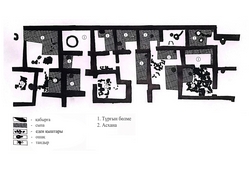
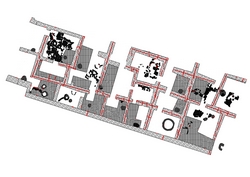
began to be constructed in a block-like arrangement, built closely adjoining
one another. The number of dwellings within a single block varied from 6 to as
many as 20 units.
The residential buildings
of this period differed from the housing models of previous centuries, yet they
also preserved a number of traditional elements. Houses constructed in a
block-like arrangement reflect the development of urbanization processes and
the increasing interconnectedness of communal life. For example, whereas in
earlier periods the tandyr was traditionally placed in the rear (honorific)
part of the dwelling, during this period it began to be installed closer to the
entrance, near the tashnau. The smoke flue of the tandyr was routed from the
corner of the room beneath the sypa, thereby functioning as a
floor-heating system. This indicates that the inhabitants of the time sought
and adopted methods for conserving and efficiently utilizing heat.
In house corners, ura storage spaces
were created for grains, using vessels such as jars and large pots. Shelves
were installed on walls to store household items, enhancing the functionality
of the dwelling.
These structural and interior changes of
16th–17th century Otyrar houses reflect efforts to improve living conditions
and demonstrate the connection between the social-economic situation of
residents and the development of architectural thinking.