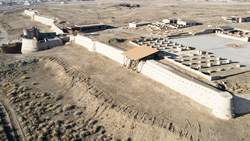
The city of Otrar
consists of parts of Kuhendiza (citadels), Medina (Shahristan) and Rabad, as
well as other cities located in Central Asia and other regions of Kazakhstan.
During this time, four rows of fortifications were built in Otrar at each
stage. The remnants of the two outer walls surrounding the Rabad part of the
city were preserved only in the north-west and west of the city.
The Shahristan part of
Otrar is planned to be preserved in the form of a pentagonal roof. In general,
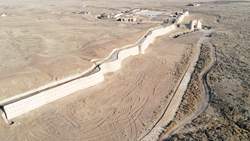
Shahristan, which is the main part of the city, is surrounded by a very strong
fortress. Today, the south-western part of the Shahristan wall is fully open
and turned into a museum under the open sky.
In general, as a result
of research of the defense systems of the city, the remnants of the fortified
walls were found at each stage.
VIII- IX centuries. The
wall is made of perfume, between which are regularly laid bricks. The internal
part is made of brick with a thickness of 0.4 m. Remove the "dress"
or "berma" with a thickness of 0.7 m made of pure cotton. Considering
that the walls of the city are usually built or repaired at the same time, the
wall, found in the upper northern part, was also built in the VIII-IX centuries
mentions.
VIII-IX centuries behind
the wall X in. A new wall was built and the reinforcement was strengthened.
During Karakhanidov's time, the walls could have been repaired. During the
renovation, a block was laid over the pahsoi, the space between the two walls
was filled with loose soil, significantly expanding the area of the fortress.
Fortress XIII century.
After the initial demolition, the walls did not recover, as in the city.
There is another indirect
testimony that the walls of Shahristan were destroyed. XIII century in the end
XIV c. Initially, they began to restore the city walls and towers. If
insignificant damage will be eliminated, then it will be removed from the east
side, even on the new, old wall. An analogous new wall was found in the
north-western part of the city. The north-eastern and north-western walls of
the city date back to the XIV century. At the beginning of the IX-XI centuries
it was completely destroyed. built on the site of the Karakhanid wall. City
walls of the XIII century. at the end of XIV c. Initially, in connection with
the change in the political situation in the Mongolian tribes, it was again
necessary to raise the need for defense. Thus, archeological excavations do not
refute the written data, but complement them.
Urban walls erected at the beginning of the XIV
century stood until the end of the XVI century. This was the last wall of
Otrar. Then, as a wall, the walls of the house began to appear.