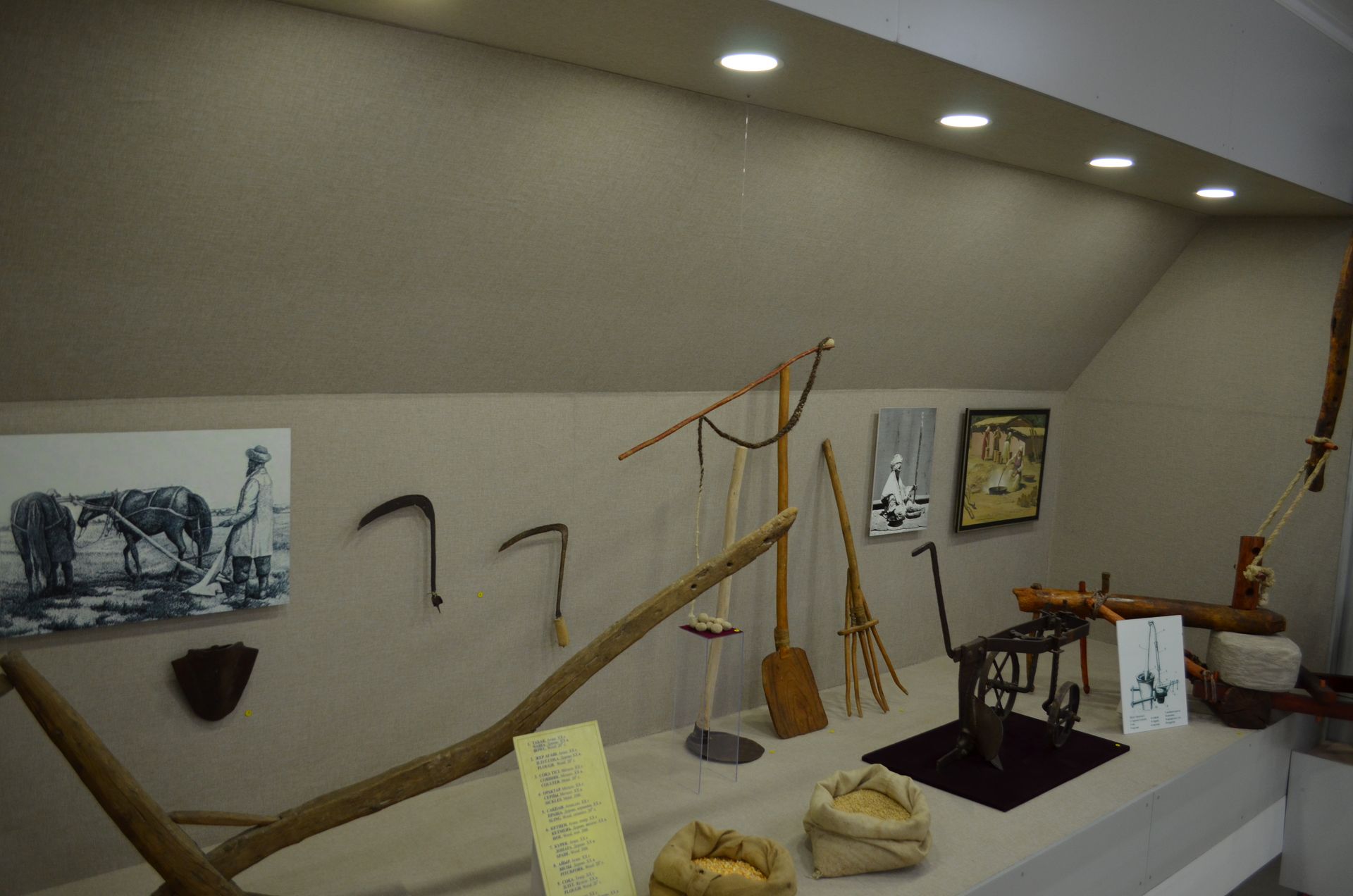
The population living in the middle reaches of the Syr Darya and on the
plains near the Aryz, Keles, and Bögen rivers has been engaged in agriculture,
not just livestock breeding, since ancient times. Academician E.A. Eversmann
noted, "They sow millet and a little barley, and they irrigate the fields
located along the riverbanks with dug-out channels."
The proximity of the Syr Darya and Aryz rivers contributed to the
development of an agricultural culture in the Otyrar oasis. Archaeological
research confirms that cereals (millet, rice, wheat), cotton, and other crops
like pumpkins, melons, watermelons, and grapes were grown here. Traces of
medieval main canals and irrigation ditches (aryks) have been found,
originating from the Aryz and Syr Darya rivers, including large canals up to 40
km long. The remains of qanat systems and water-lifting devices (shyghyr) also
prove that irrigated agriculture existed here from ancient times. These systems
gradually fell into disuse in the 18th and 19th centuries.
In the late 19th and early 20th centuries,
agriculture was revived. At the "Shauildir Congress" in 1930, a
decision was made to transition to a settled lifestyle, unite, dam the Aryz
river, and dig the Shauildir canal. A resident of the Shauildir village,
Duysenbay Altynbekov, called on the people to take up farming and build the
canal together.
In 1931-1932, the first collective farms were organized in the area, a
machine and tractor station was opened, and tractors began to operate. The
Kökmardan, Köksaray, and Qulan canals were built. In the 1950s, new lands were
actively developed in the valleys of the Keles, Bögen, and Aryz rivers for
growing cotton and other crops.