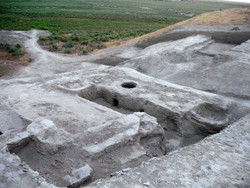
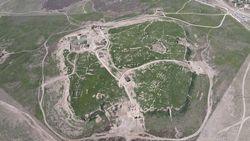
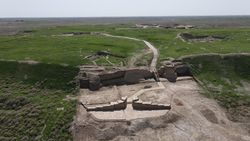
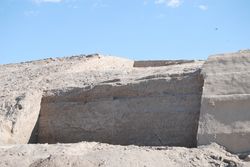
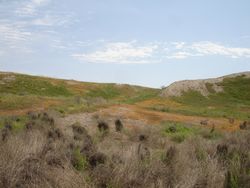
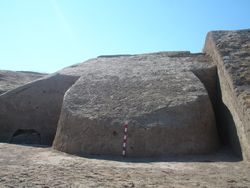
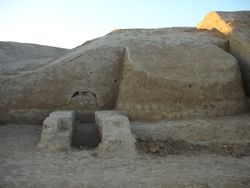
The Sopykhana Gate is not visible in
the settlement’s topography because, after the Mongol invasions, it was
completely reinforced, converted into a continuous wall, and taken out of use.
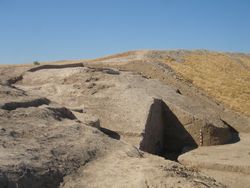
Located at the junction of the shakhristan and the citadel, the gate was
built contemporaneously with the Northern Gate in the 8th century.
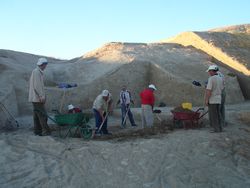
Archaeological research has shown that the structure and layout of the two
gates are very similar.
In written sources, the Sopykhana
Gate is referred to as Darwaza-i-Sufi. This name originates from Persian
and is associated with the religious figure Sufi Arystanbab, as the road
emerging from this gate led to his tomb.
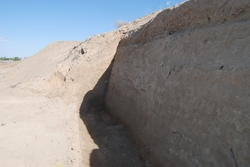
After the Mongol invasions, at the
end of the 13th century and the beginning of the 14th century, the city walls
and towers began to be restored. At that time, the site of the Sopykhana Gate
was reinforced with solid masonry, integrated into the wall, and its use as an
internal gate ceased. Following this modification, the outer gate was left
unattended, reducing its significance. Additionally, construction materials
from the gate may have been reused for other buildings, and auxiliary
structures such as the guardhouse on the inner side were not preserved.
The Sopykhana Gate was one of the most important
gates of Otyrar before the Mongol invasions.